
Fair Wage Project
The Project After One Year
Workshops
To expose MESH suppliers to the Fair Wage Guide we conducted two Fair Wages workshops one in south India at Karigiri and one in north India in Delhi. The groups were asked if they would like to participate in the Fair Wage Project managed by MESH which will teach them how to use Fair Wage Guide developed by World of Good. Totally 19 groups participated in these workshop and responded that they would like our help to review their wages using the Fair Wage Guide
Field Work
The field worker has visited nine groups in south India. When we checked the artisan wages against national and international parameters the Fair Wage Guide showed us that at each and every stage the artisans are getting different wages. Our findings are that often as many as 5 or 7 artisans may be involved in making a product but wage rates at each stage are different. Sometimes they are below the Absolute Poverty Line , sometimes above the Absolute Poverty Line, but below the State Minimum Wage , occasionally they are above the State Minimum Wage but below the Acumen Poverty Line and also sometimes above the Acumen Poverty Line.
During the field work the production timings were checked as the artisans made products in our presence. Often we found different timings from those used in their cost sheets. When entering the new timing details into the Fair Wage Guide we saw some difference in the wages just based on fresh timing information.
In each place we prepared three sets of cost sheets with wages at the Absolute Poverty Line, State minimum Wage and Acumen Poverty Line. In some cases we saw that at each wage level there was only a small difference in the final selling price and some cases the difference was more. Where the difference was small we encouraged the group to consider paying at the highest amount without changing their selling price. Where the improved wage was going to result in a higher selling price we encouraged the groups to go for the higher selling price and find out from MESH if the product would still be attractive to customers.
We discussed to the artisans about what state and local benefits might be available to meet more expensive personal costs such as those for health care, education, accommodation and savings. Where those benefits were provided by the group their contribution was considered alongside the actual wage paid.
Observations
To expose MESH suppliers to the Fair Wage Guide we conducted two Fair Wages workshops one in south India at Karigiri and one in north India in Delhi. The groups were asked if they would like to participate in the Fair Wage Project managed by MESH which will teach them how to use Fair Wage Guide developed by World of Good. Totally 19 groups participated in these workshop and responded that they would like our help to review their wages using the Fair Wage Guide
Field Work
The field worker has visited nine groups in south India. When we checked the artisan wages against national and international parameters the Fair Wage Guide showed us that at each and every stage the artisans are getting different wages. Our findings are that often as many as 5 or 7 artisans may be involved in making a product but wage rates at each stage are different. Sometimes they are below the Absolute Poverty Line , sometimes above the Absolute Poverty Line, but below the State Minimum Wage , occasionally they are above the State Minimum Wage but below the Acumen Poverty Line and also sometimes above the Acumen Poverty Line.
During the field work the production timings were checked as the artisans made products in our presence. Often we found different timings from those used in their cost sheets. When entering the new timing details into the Fair Wage Guide we saw some difference in the wages just based on fresh timing information.
In each place we prepared three sets of cost sheets with wages at the Absolute Poverty Line, State minimum Wage and Acumen Poverty Line. In some cases we saw that at each wage level there was only a small difference in the final selling price and some cases the difference was more. Where the difference was small we encouraged the group to consider paying at the highest amount without changing their selling price. Where the improved wage was going to result in a higher selling price we encouraged the groups to go for the higher selling price and find out from MESH if the product would still be attractive to customers.
We discussed to the artisans about what state and local benefits might be available to meet more expensive personal costs such as those for health care, education, accommodation and savings. Where those benefits were provided by the group their contribution was considered alongside the actual wage paid.
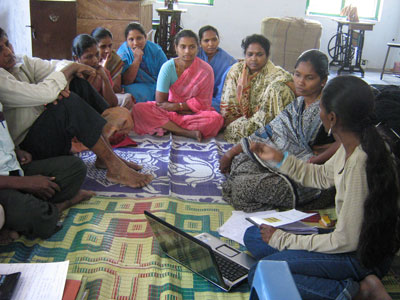
T. Mary Rani demostrating The Fair Wage Guide in Bethany Leprosy Colony
Observations
- Many artisans in the groups supplying MESH have been paid below the state minimum wage. In some institutional based groups there are other benefits which make the wage part of a total package. Small self-help artisan groups are beginning to register with the Government of India and will become eligible for some subsidised benefits. A few groups have low wages and no benefits at all.
- All the groups co-operated with the field worker and showed an interest to increase their wages.
- In general there was no indication that women were paid less for the same work than men. (There was one exception but the women worked more slowly than the men)
- It seems that the income from handicraft production is unlikely to meet all the artisan’s expenses. The artisan needs other benefits (free or subsidised) to meet the cost of health care, education and savings for old age.
- The field worker used the Fair Wage Guide with artisans and rehab unit managers. In some cases there was a higher authority to decide on wage changes, the field workers should have prepared a report or made a presentation of the findings to that level of management.
- In institutions the management expressed difficulty to increase the wages of crafts artisans without increasing wages of other workers i.e. In Bethany Leprosy Colony they were reluctant to increase weavers' wages unless they could also afford to increase office staff and gardeners' wages. We had not expected this obstacle.
- Several of the groups were able to understand the Fair Wage Guide when with the field worker but their limited education levels would make it difficult to use it alone in the future.
- In at least one case the management was found to be claiming more for labour in the cost sheet and final price than it was paying to the artisans. MESH has no power to change that situation but can raise it as an issue for attention.
