
Fair Wage Project
Fair Wages the sensitive Way - Report on the visit to Little Flower, a Leprosy Community in Raxaul, Bihar.
One of our concerns when we considered the best way to use the Fair Trade Wage Guide was not wishing to cause unrest amongst groups of artisans in institutions where payment in wages is only one part of the total benefit package. Little Flower Leprosy Colony is just such an example. Under the management of Brother Christudas there are many income generation and social welfare activities funded from a central kitty. Some members of the colony do agricultural work, others work in the hospital and still others work in the weaving and spinning and sewing workshops. All are provided with free housing, free education and often hostel facilities for their children, free health care and electricity at a highly subsidised rate. The income from all the income generating activities is pooled to provide the social welfare and support services.
Bearing that in mind it was decided that Sunil Singh from Manthan, who is providing consultancy support for the MESH Fair Wage Project should visit Brother Christudas in Little Flower Leprosy Colony to discuss the Fair Trade Wage Guide. Only after Brother had seen the guide and the issues regarding payment of fair wages had been discussed in full would the topic be open for further discussion with the artisans and then only with his guidance.
Shiv, the supervisor from the weaving unit and one artisan had earlier attended a two day workshop conducted by MESH in Delhi at which the Wage Guide was demonstrated and fully discussed in the context of Fair Trade.
Mr. Sunil Singh reports from his visit to Little Flower: Br.Christudass realised the concern of MESH for Little Flower towards the sensitive issue of artisan’s wage. After showing him the wage guide and explaining the poverty parameters used it was agreed that Mr. Sunil Singh would meet with two groups of artisans to discuss costing and pricing. He reports:
I started the group discussion on costing with two groups of artisans (7 female and 4 male in first group and 9 female and 4 male in second group). I thought they at least they would know a little bit about the cost involved in their products but unfortunately they were blank on that front.
The artisans (particularly women) were surprised to know about the costs involved in prodiction in Little Flower. They are only aware about their wage on the basis of piece rate and on an average they get a minimum of Rs 800 to a maximum of Rs 1600 per month as per the availability of MESH and Local orders. The other costs involved apart from the artisans’ wage, only Mr Shiv and one or two male artisans have information. Women artisans were really surprised to know that their product is also covering the rent and electricity (Rs 2500 and Rs2000 per month) of the work place/premises. They were not aware about this, so it was a big surprise for them.
Then I explained to them (with inputs of Shiv who is the unit supervisor) that for a product costing, we include the cost of raw material, wage of artisans labour cost (which they call “Banihari”), Rent, electricity, monthly salary of the persons/artisans involved but not weaving, miscellaneous and the profit for the organisation. It was made clear that they are getting the wage on piece rate (Rs20 for a scarf and they are weaving three scarves in a day so they will earn Rs.60 per day) and other members of the organisation are working on a monthly basis. They are not engaged in weaving but they are involved to complete the process for a final product and supply for sale.
Mr. Sunil Singh later reports: Shiv said, we never thought to share the process of costing with women artisans. There is no use for them. He wandered at the need to inform the artisans about the whole steps/stages of cost involvement in a product
Shiv’s attitude replicates what we have seen in Bethany Leprosy Colony in south India where a primarily female workforce knew nothing about the costing or finances of their workshop and never threw up a leader. That changed last year when MESH started to invite women for design workshops and began to deal directly with them on the phone for product development issues. As they began to be given responsibilities they began to seek to know more and to fight to ensure more efficient systems that would result in less breaks in employment.
Sunil Singh further reports about his time in Little Flower: The good thing of this whole exercise was the pleasant surprise for artisans about the cost of a product. I encouraged them to feel proud that with their collective efforts the whole system is running without any other financial support. Through the efforts/labour of all artisans (weavers as well as those who work on the farm) they receive not just their wage but all the other benefits too. I explained that their income depends on the frequency of job-orders but they are close to sustainability. The profit earned through product is saved by the organisation for future and emergency. I did not use the Fair Wage Guide or compare their wages with the four parameters and was not even comfortable to consider doing so. But the whole exercise was a healthy discussion and also participatory, which encouraged me.
The issue of fair wages is straight forward to us in MESH. Artisans need to have the means to feed, cloth, shelter, educate, provide health care and save for the future. If that is provided alone through a wage or with a smaller wage and other benefits then we are satisfied. That is why our Fair Wage work in Little Flower was different to what it has been with other artisan groups where those six living components must be provided for only from their wages.
Jacky Bonney
Executive Secretary MESH
10.10.2009
Bearing that in mind it was decided that Sunil Singh from Manthan, who is providing consultancy support for the MESH Fair Wage Project should visit Brother Christudas in Little Flower Leprosy Colony to discuss the Fair Trade Wage Guide. Only after Brother had seen the guide and the issues regarding payment of fair wages had been discussed in full would the topic be open for further discussion with the artisans and then only with his guidance.
Shiv, the supervisor from the weaving unit and one artisan had earlier attended a two day workshop conducted by MESH in Delhi at which the Wage Guide was demonstrated and fully discussed in the context of Fair Trade.
Mr. Sunil Singh reports from his visit to Little Flower: Br.Christudass realised the concern of MESH for Little Flower towards the sensitive issue of artisan’s wage. After showing him the wage guide and explaining the poverty parameters used it was agreed that Mr. Sunil Singh would meet with two groups of artisans to discuss costing and pricing. He reports:
I started the group discussion on costing with two groups of artisans (7 female and 4 male in first group and 9 female and 4 male in second group). I thought they at least they would know a little bit about the cost involved in their products but unfortunately they were blank on that front.
The artisans (particularly women) were surprised to know about the costs involved in prodiction in Little Flower. They are only aware about their wage on the basis of piece rate and on an average they get a minimum of Rs 800 to a maximum of Rs 1600 per month as per the availability of MESH and Local orders. The other costs involved apart from the artisans’ wage, only Mr Shiv and one or two male artisans have information. Women artisans were really surprised to know that their product is also covering the rent and electricity (Rs 2500 and Rs2000 per month) of the work place/premises. They were not aware about this, so it was a big surprise for them.
Then I explained to them (with inputs of Shiv who is the unit supervisor) that for a product costing, we include the cost of raw material, wage of artisans labour cost (which they call “Banihari”), Rent, electricity, monthly salary of the persons/artisans involved but not weaving, miscellaneous and the profit for the organisation. It was made clear that they are getting the wage on piece rate (Rs20 for a scarf and they are weaving three scarves in a day so they will earn Rs.60 per day) and other members of the organisation are working on a monthly basis. They are not engaged in weaving but they are involved to complete the process for a final product and supply for sale.
Mr. Sunil Singh later reports: Shiv said, we never thought to share the process of costing with women artisans. There is no use for them. He wandered at the need to inform the artisans about the whole steps/stages of cost involvement in a product
Shiv’s attitude replicates what we have seen in Bethany Leprosy Colony in south India where a primarily female workforce knew nothing about the costing or finances of their workshop and never threw up a leader. That changed last year when MESH started to invite women for design workshops and began to deal directly with them on the phone for product development issues. As they began to be given responsibilities they began to seek to know more and to fight to ensure more efficient systems that would result in less breaks in employment.
Sunil Singh further reports about his time in Little Flower: The good thing of this whole exercise was the pleasant surprise for artisans about the cost of a product. I encouraged them to feel proud that with their collective efforts the whole system is running without any other financial support. Through the efforts/labour of all artisans (weavers as well as those who work on the farm) they receive not just their wage but all the other benefits too. I explained that their income depends on the frequency of job-orders but they are close to sustainability. The profit earned through product is saved by the organisation for future and emergency. I did not use the Fair Wage Guide or compare their wages with the four parameters and was not even comfortable to consider doing so. But the whole exercise was a healthy discussion and also participatory, which encouraged me.
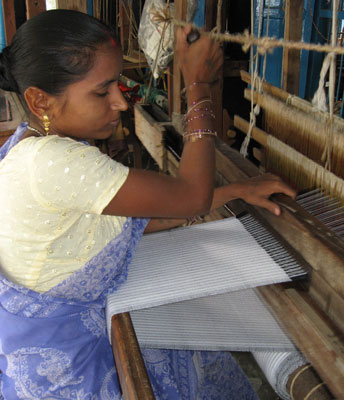
Little Flower weaver
The issue of fair wages is straight forward to us in MESH. Artisans need to have the means to feed, cloth, shelter, educate, provide health care and save for the future. If that is provided alone through a wage or with a smaller wage and other benefits then we are satisfied. That is why our Fair Wage work in Little Flower was different to what it has been with other artisan groups where those six living components must be provided for only from their wages.
Jacky Bonney
Executive Secretary MESH
10.10.2009
